

Industrial blowers play an essential role in processes that require
a continuous supply of air or gas. From wastewater treatment and
pneumatic conveying to cement production and chemical processing,
the right blower can influence system performance, maintenance
requirements and operating costs.
Among the most commonly used positive displacement blowers are
twin-lobe and tri-lobe blowers. Both operate on
similar principles, but their rotor designs can affect airflow
pulsation, noise and suitability for different applications.
Understanding these differences can help you select the right
solution for your facility.
What Is a Positive Displacement Blower?
A positive displacement blower moves air or gas by trapping a volume
between rotating components and the blower casing. The trapped air
is carried from the inlet to the discharge side.
These blowers are widely used in industrial processes where a
consistent flow of air or gas is required. The pressure developed
depends on the resistance of the connected system and the blower’s
operating conditions.
Both twin-lobe and tri lobe blowers belong to this
category.
What Is a Twin-Lobe Blower?
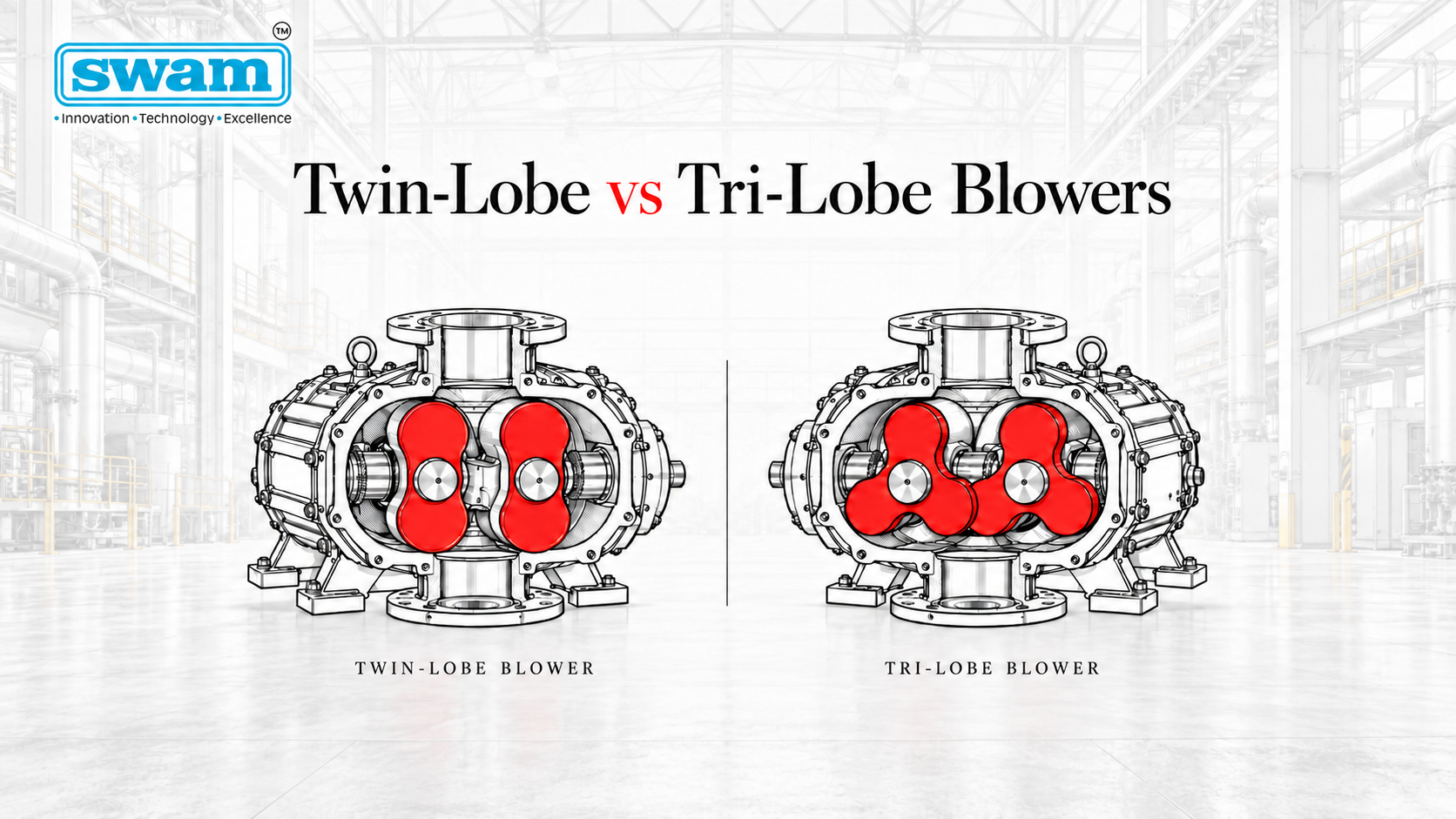
A twin-lobe blower uses two rotors, each with two
lobes. The rotors rotate in opposite directions inside a casing,
carrying air or gas from the inlet side to the discharge side.
Timing gears keep the rotors correctly positioned so they do not
touch each other. This arrangement supports oil-free conveyance in
the working chamber.
Twin-lobe blowers have been used across industries for many years
because of their robust design and ability to handle demanding
applications.
What Is a Tri Lobe Rotary Piston Blower?
A tri lobe rotary piston blower uses two rotors,
each with three lobes. Like a twin-lobe blower, it moves air or gas
through the casing as the synchronized rotors turn in opposite
directions.
The additional lobe changes how air is delivered. This design can
reduce pressure pulsations compared with a similar twin-lobe design,
helping provide smoother airflow.
Tri lobe blowers are often considered for applications where noise,
vibration and consistent operation are important factors.
Common Industrial Applications
2Twin-Lobe Blowers
- Pneumatic conveying of cement, fly ash and other bulk materials
- Wastewater treatment and aeration
- Vacuum conveying
- Food and grain handling
- General industrial air movement
1Tri-Lobe Blowers
- Wastewater treatment plants
- Aeration systems
- Pneumatic conveying
- Aquaculture systems
- Cement and chemical processing
- General industrial applications
SWAM’s twin-lobe rotary blowers are designed for applications
requiring reliable airflow, including bulk material conveying,
aeration and vacuum operations.
Twin-Lobe vs Tri-Lobe Blowers: Key Differences
| Factor | Twin-Lobe Blower | Tri Lobe Rotary Piston Blower |
|---|---|---|
| Rotor design | Two lobes on each rotor | Three lobes on each rotor |
| Operating principle | Positive displacement | Positive displacement |
| Airflow pulsation | Generally higher than a similar tri-lobe design | Generally lower due to the three-lobe rotor design |
| Noise and vibration | Can be higher, depending on the complete system | Can be lower, depending on the complete system |
| Design | Established, relatively simple rotor configuration | Rotor configuration designed to support smoother discharge |
| Typical uses | Conveying, aeration and vacuum applications |
Aeration, conveying and applications where smoother operation is desirable |
Note: Actual performance depends on the blower
model, speed, pressure, installation, silencers and other system
components.
1. Rotor Design
The main visible difference is the number of lobes on each rotor.
A twin-lobe blower has two lobes per rotor, while a
tri lobe rotary piston blower has three lobes per rotor.
Both designs use a pair of synchronized rotors to move air or gas
through the blower.
The number of lobes affects the way air is trapped and discharged,
which can influence pulsation and operating characteristics.
2. Airflow Pulsation
Airflow pulsation refers to fluctuations in pressure as air is
discharged from the blower.
In general, tri lobe blowers produce more frequent
but smaller discharge pulses than comparable twin-lobe designs. This
can help reduce pulsation in the connected system.
Pulsation is also affected by blower speed, pipework, silencers and
operating pressure. A properly designed installation is important for
either type.
3. Noise and Vibration
Noise is an important consideration, especially in facilities where
blowers operate continuously or are installed near working areas.
A tri lobe rotary piston blower may offer quieter operation because
of its lower pressure pulsation. However, every model and installation
is different; a tri-lobe blower will not automatically be quieter
than every twin-lobe blower.
The overall noise level depends on factors such as:
- Blower size and operating speed
- Inlet and discharge silencers
- Acoustic enclosure
- Piping arrangement
- Mounting and vibration isolation
- Maintenance condition
4. Energy Efficiency
Both twin-lobe and tri lobe blowers can support industrial operations,
but the number of lobes alone does not determine energy
efficiency.
Efficiency depends on the complete operating system, including:
- Required airflow and pressure
- Blower size and design
- Rotor clearances
- Motor and drive efficiency
- Operating speed
- Pressure losses in filters and pipelines
- Actual demand compared with blower output
Selection tip: For an accurate comparison, request
performance data for both options at the same flow and pressure
conditions. This helps you compare power consumption on a practical
basis.
5. Maintenance and Reliability
Both designs require regular maintenance to support reliable
operation. Typical activities include checking filters, lubricants,
belts or couplings, bearings and operating temperatures.
Reliability depends on equipment quality, correct installation,
operating conditions and maintenance practices.
Selecting a blower designed for the application is particularly
important when handling process gases, high temperatures, moisture
or demanding duty cycles.
Which Blower Should You Choose?
The right choice depends on your process requirements. Before
selecting a blower, consider:
-
Required airflow: How much air or gas does the
process need? -
Operating pressure: What pressure is required at
the application point? -
Application: Is the blower being used for
aeration, conveying or gas handling? -
Operating hours: Will it run continuously or
intermittently? -
Noise requirements: Does the installation need
an acoustic enclosure? -
Energy consumption: What is the expected power
requirement at the duty point? -
Site conditions: Are there limits on space,
temperature or maintenance access?
A twin-lobe blower may be suitable for an application requiring a
robust and proven design. A tri lobe rotary piston blower may be
worth considering when reducing pulsation and noise is a priority.
The final selection should be based on a comparison of equipment at
your actual operating conditions.
Choose the Right Blower with SWAM
SWAM offers a range of industrial blower solutions, including
twin-lobe and tri lobe blowers, for applications across multiple
industries.
Whether your requirement involves wastewater aeration, pneumatic
conveying or another industrial process, the right equipment
selection starts with understanding your flow, pressure and
operating conditions.
Looking for the right blower for your application?
Explore SWAM Blowers